

highlight
·Balancing classic sightseeing with local experiences
·Fully guarantee free time and travel calmly and leisurely
·Even first-time users can rest assured of the support system
journey
Begin your wonderful journey today.
08:00 Meet in front of JR Tokyo Station, under the BEAMS sign at Shin-Marunouchi Building (pickup & drop-off plan)
Address: Shin-Marunouchi Building, 1-5-1 Marunouchi, Chiyoda City, Tokyo 100-6590, Japan
08:30 Shinjuku Mode Gakuen (pickup & drop-off plan)
Please note that the tour will depart on time. We recommend arriving at the meeting point at least 10 minutes in advance.
▼Great Buddha of Kamakura (30-minute stop)
The Great Buddha of Kamakura is a bronze seated statue of Amida Buddha located at Kotoku-in Temple, a Jodo sect temple in the historic city of Kamakura. As a symbol of Kamakura, the statue stands 11.3 meters tall (13.35 meters including the base) and weighs approximately 121 tons. Constructed in 1252, its calm facial expression, relatively low ushnisha, and slightly forward-leaning posture reflect the influence of Song Dynasty Buddhist sculpture, which was popular during the Kamakura period. It is recognized as a representative work of the era and has been designated a National Treasure of Japan. Unlike the Great Buddha at Todai-ji in Nara, which has undergone multiple restorations, the Kamakura Daibutsu has largely retained its original form, making it exceptionally valuable.
Minamoto no Yoritomo established Japan’s first samurai government, the Kamakura Shogunate (1192–1333), in this city. During these 140 years, Kamakura flourished as the political, economic, and cultural center of Japan. However, with the rise of the Muromachi Shogunate, its central role diminished, and the city gradually declined. Following the Battle of Koga in 1455, Kamakura was reduced to a village primarily sustained by agriculture and fishing. It was not until the mid-Edo period, with the revival of shrines and temples, that Kamakura regained prominence and developed into one of Japan’s major tourist destinations.
(Admission fee not included: 300 yen / Inside the Buddha: 50 yen)
▼Enoden Experience from Hase Station (Approx. 15–20 minutes walk to Hase Station)
You will walk to Hase Station and board the Enoden train. The fare for the Enoden experience is included in the tour.
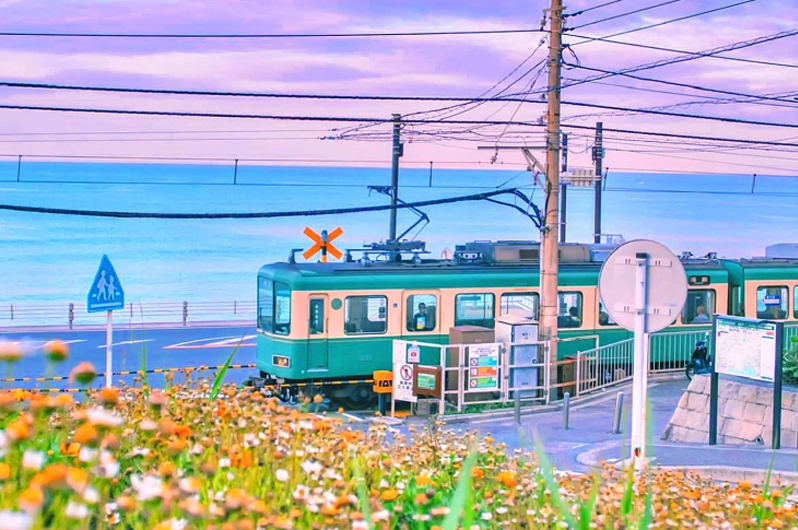
The Enoden is a local tram line connecting Fujisawa and Kamakura. It passes by many of Kamakura’s famous attractions and offers scenic views of the beautiful Shonan coastline. As an iconic mode of transportation in Kamakura, the Enoden is frequently featured in Japanese films and anime, especially scenes of the train running through residential streets. This experience allows you not only to view it from afar but also to enjoy riding it firsthand.
The route will be Hase Station → Kamakurakokomae Station → Enoshima Station via the Enoden.
Please make sure to stay with the guide on the way to the station. If you become separated from the group, you will be responsible for your own arrangements.
This experience is provided as a complimentary service. No refunds will be issued if the Enoden cannot be boarded due to unforeseen circumstances.*
▼Kamakura High School (20-minute stop)
Kamakura High School, located in Kamakura City, Kanagawa Prefecture, is known as the model for Ryonan High School in the famous anime Slam Dunk. The railway crossing near the station is the iconic filming location where Hanamichi Sakuragi greets Haruko Akagi. Standing at this crossing, with the sound of the bells ringing, brings back vivid memories of youthful passion from the series.
Even after many years, visitors still come here to take photos, as if capturing and commemorating their own青春 memories. What people experience here is not merely nostalgia, but a chance to reconnect with the sea, the school, and the streets that once symbolized their youth—reliving that fleeting moment of青春 before gently saying goodbye to it.
Shonan Coast (drive-by only, not included as a stop)
The Shonan Coast offers a variety of impressions: the Enoden train slowly passing through Kamakura’s charming streets, the soothing sound of waves along the beach, and the refreshing sea breeze felt while riding along the coast. It embodies the spirit of Slam Dunk—a place filled with passion, nostalgia, and heartfelt emotion, much like Sakuragi’s feelings for Haruko.
▼Enoshima (Approx. 110 minutes)
According to legend, Enoshima was formed in April of the 13th year of Emperor Kinmei’s reign (552 AD), when sand rose from the seabed and gradually formed an island over the course of 21 days. Another account recorded at Enryaku-ji Temple on Mount Hiei tells a captivating story about its origin. Long ago, the area around Tsunomura (present-day Kamakura) was a vast lake inhabited by a five-headed dragon. The dragon caused earthquakes, disease, floods, and storms, bringing devastation to the region and leaving villages abandoned.
One day, the sky darkened and the earth trembled. A beautiful celestial maiden appeared from the clouds, and suddenly an island rose from the sea. The dragon fell in love with her at first sight, vowed to abandon its evil ways, and proposed to her. Through sincere repentance and good deeds, the dragon eventually won her heart, and they were united. From then on, the dragon, together with the gods, protected the island and its people. It is also said that this dragon was a manifestation of Benzaiten. Even Tokugawa Ieyasu is believed to have visited and worshipped here. During the Edo period, Enoshima became a popular sightseeing destination for people from Edo (modern-day Tokyo), and due to Benzaiten’s association with music, it was also favored by Kabuki performers.
Enoshima Shrine
Enoshima Shrine was established in 552 AD and holds its annual main festival in early April. The shrine houses many nationally designated cultural treasures, including a wooden, colored seated statue of Eight-Armed Benzaiten, a sword crafted by Fujiwara Masahiro of Hizen Province, the “All-Direction-Gazing Turtle,” the Enoshima Engi (origin records), and a bronze torii gate. Benzaiten is also worshipped as a deity of wealth, attracting many visitors and worshippers. Nearby, the “Zeniarai Hakuryuo” (Money-Washing White Dragon King) is believed to bring financial luck if coins are washed in its sacred water.
▼Tsurugaoka Hachimangu Shrine (70-minute stop)
Tsurugaoka Hachimangu, formerly known as Kamakura Hachimangu, served as the central place of worship and guardian deity for samurai during the Kamakura Shogunate period (1192). It has deep historical ties with Minamoto no Yoritomo, the first shogun of Kamakura, and is one of the most प्रसिद्ध shrines in the Kanto region. It is also counted among the Three Great Hachimangu Shrines of Japan, alongside Iwashimizu Hachimangu in Kyoto and Usa Hachimangu in Oita.
The shrine grounds are expansive and include several sites designated as National Historic Sites. With a wide variety of seasonal flowers, it is also a well-known spot for cherry blossom and autumn foliage viewing. Additionally, it has been awarded one star in the Michelin Green Guide.
Komachi Street
Komachi Street, stretching from Kamakura Station to Tsurugaoka Hachimangu, is one of Kamakura’s most famous and lively shopping streets. Lined with numerous shops on both sides, it offers a wide range of goods, including local specialties, traditional Japanese crafts, and regional cuisine. It is highly popular among both locals and tourists, and many of its well-known eateries are featured on major websites and guidebooks. Be sure not to miss it while passing through.
Return to Tokyo city.
The return time is for reference only and may be earlier than scheduled depending on the day’s itinerary progress and traffic conditions.
Upon arrival at JR Tokyo Station Marunouchi North Exit or Shinjuku Mode Gakuen, your enjoyable day tour comes to an end.
Guests using the pickup and drop-off plan may disband directly at either Tokyo Station or Shinjuku.
Tokyo Station (Tokyo Station Hotel) is located in the Marunouchi business district of Chiyoda City, Tokyo. It is a major multi-level terminal station serving numerous lines, including the Tohoku, Yamagata, Akita, Joetsu, and Hokuriku (Nagano) Shinkansen lines, as well as the Tokaido Line, Chuo Line (Rapid), Sobu Line (Rapid), Yokosuka Line, Keiyo Line, Yamanote Line, Keihin-Tohoku Line, Narita Express, Tokaido Shinkansen, and the Tokyo Metro Marunouchi Line (station code: M-17). It functions as a key gateway to destinations across Japan and is one of Tokyo’s primary transportation hubs. Its iconic red-brick station building is designated as an Important Cultural Property of Japan and was beautifully restored in 2012 to reflect its original appearance from over a century ago.
Shinjuku is one of Tokyo’s most famous and vibrant commercial districts, centered around Shinjuku Station and extending into areas such as the East Exit, West Exit, and South Exit. It is a shopper’s paradise, offering department stores, electronics retailers, drugstores, and fashion boutiques. Well-known department stores such as Odakyu, Keio, and Isetan are popular choices.
Shinjuku is also home to Kabukicho, Japan’s most famous entertainment district, filled with countless restaurants, bars, karaoke venues, and nightlife establishments, earning it the nickname “Japan’s No.1 entertainment district.”
Shinjuku Station is one of the most important transportation hubs in Tokyo, with nearly 4 million passengers daily, making it the busiest railway station in the world. Nearby attractions include Shinjuku Gyoen National Garden, the Tokyo Metropolitan Government Building, and Golden Gai.
The above itinerary schedule may be subject to change due to weather, traffic conditions, or other unforeseen circumstances. Thank you for your understanding.
Fees Included
- Transportation service as specified in the itinerary
- Fuel costs, tolls, and expressway fees
- Vehicle service duration: within 10 hours (in accordance with Japanese regulations)
- Driver-guide service fee (Small group of 1–13 people; bus group of 14–45 people, subject to adjustment based on the number of participants on the day)
-
Reference vehicle types:
- 5–8 seats: Toyota Alphard
- 9–14 seats: Toyota Hiace or equivalent
- 18–22 seats: Minibus
- 22 seats and above: Large bus
Vehicle type is for reference only and will be adjusted according to the number of participants on the day - Children aged 0–2 who do not occupy a seat may join free of charge (please inform in advance at the time of booking); children aged 3 and above are charged the adult rate
Fees Not Included
- Accommodation, meals, optional local activities, and other personal expenses
- Any items not mentioned in the “Fees Included” section
[This tour allows free luggage. Please inform us of the number of luggage items when booking.]
(1) Once the booking is confirmed, the travel date cannot be changed. Any losses caused by changes will be borne by the customer.
(2) Please provide accurate information at the time of booking (name, number of participants, phone number, WeChat ID, and pick-up location). We are not responsible for issues caused by incorrect or incomplete information.
(3) Please keep your passport and valuables with you at all times during the trip. We are not responsible for any loss, theft, or damage.
(4) Elderly guests, individuals with cardiovascular conditions such as hypertension or heart disease, and pregnant women are advised to be accompanied by a family member.
(5) Solo participation for guests under 18 years old is not accepted. Minors must be accompanied by a guardian to join the tour.
(6) This is a shared group tour. Please strictly follow the designated stop durations and the instructions of the guide and driver. For more flexible arrangements, please consider our private tour service.
(7) No refunds will be issued for late arrival, personal reasons, or failure to participate in the tour.
(8) Leaving the group voluntarily during the tour will be regarded as contract termination, and no refund will be given. Any resulting personal or property risks will be the responsibility of the participant.
(9) Arrival times may vary due to traffic, weather, holidays, or crowd conditions. Delays or cancellations caused by force majeure are not refundable.
(10) Please wear comfortable clothing and suitable walking shoes.
(11) Please comply with Japanese laws and do not carry prohibited items. Any violations are the responsibility of the participant.
(12) During free time, please ensure your own safety and take care of your belongings. Any accidents or losses are at your own risk.
Important Itinerary Notes
Due to unpredictable factors such as traffic conditions, weather, holidays, or crowd levels on the day, arrival times for each itinerary may be subject to change. According to Japanese law, the maximum working time for drivers is 10 hours. For safety and operational stability, the itinerary may be adjusted accordingly, including shortening the stay at certain attractions or canceling some stops. We sincerely ask for your understanding and support regarding these necessary adjustments.
In cases of the above-mentioned or other force majeure events, we regret that no refunds will be provided. This policy is implemented to prioritize the safety of both drivers and passengers and to ensure the smooth operation of the tour.
We are always committed to providing the best possible travel experience; however, adjustments to the itinerary may be made flexibly depending on actual conditions. We appreciate your understanding and cooperation.
Force majeure events include, but are not limited to:
• Natural disasters: earthquakes, volcanic eruptions, floods, typhoons, etc.
• Traffic incidents: road accidents, traffic congestion, etc.
• Weather conditions: heavy snow, heavy rain, thick fog, etc.
• Government regulations: emergency laws, traffic restrictions, etc.
• Health emergencies: sudden illness of passengers or staff
• Social events: strikes, protests, civil unrest, etc.
• Mechanical failures: vehicle breakdowns, etc.
Cancellation 3 days before departure (excluding the departure date): 100% refund
Cancellation 2–3 days before departure (including the departure date): 50% refund
Cancellation 1 day before departure (including the departure date): no refund
English:
1. Pickup / Meeting
(1)Please arrive at the designated meeting point at the specified time. Late arrival is not allowed. This product does not allow changes, refunds, transfers to other departures, or joining midway. If you fail to join the tour for personal reasons, any loss will be your responsibility.
2. During the Tour
(1)You are not allowed to leave the group or depart midway. If you choose to leave the group, any unused portion will be considered voluntarily waived, and no refund will be issued. Any incidents after leaving the group are your own responsibility.
(2)During peak seasons or special circumstances, departure times may be adjusted earlier or later (final time is subject to the guide’s announcement).
(3)Itinerary order and stay duration may be adjusted based on traffic, weather, or other conditions, while ensuring all listed attractions are included.
(4)Meals are not included in this tour and are at your own expense. Some restaurants may not allow outside food or may require ordering.
3. Local Customs / Regulations
(1)Please respect local culture and customs.
4. Weather
(1)The itinerary may be adjusted due to weather or safety considerations. Staff may request suspension of outdoor activities if necessary for safety reasons.
(2)In cases of severe weather or force majeure, attraction opening hours, shows, or performances may be changed or canceled without prior notice.
(3)Flower blooming conditions are weather-dependent. Tours will still operate even if flowers are not at peak bloom.
5. Meals
(1)Meals are not included and are at your own expense.
6. Shopping
(1)Shops and rest areas visited during the tour are not official shopping stops designated by the travel agency. Please make purchases at your own discretion and keep receipts if needed.
(2)Some venues may be privately operated without formal authorization. Please exercise caution when spending.